Showing posts with label Storytelling. Show all posts

Monday, November 24, 2014

Storytelling for Week 14: The Cruel Crane Outwitted

The Cruel Crane Outwitted

Once upon a time there was a very cruel, very rich man. He did what he could to benefit himself, not caring about how his actions might affect those around him. For a very long time he acted in this manner, not really paying attention to the other villagers, viewing them as below him. This all changed one day, however, when he discovered just how much he could gain by taking advantage of them. The day that this all began to change, for both Richard and for the poor villagers, was the day that the drought truly began to take effect. It had not rained in a week and the crops were beginning to do poorly, burning in the sunlight without any water. The villagers came to ask to use Richard's well, as the main well for the village had begun to evaporate. Richard, not caring what happened to the others, refused them at first. After turning them away, he realized that he could force them to work for him in return for having access to water. They would have to do as he said, unable to argue, so long as the drought continued. After another week of no rain, the people returned to beg him for mercy. He agreed, granted that certain conditions of his were met prior to them gaining access. He forced them to agree to work as servants within his house, as well as making them take care of his property and its orchards. Reluctantly the people agreed, knowing that they were at his "mercy" until the rains returned. After working under Richard for over a month, some of the people began to complain, saying it was unfair for them to be working so hard while Richard reaped all of the rewards. The next day, these people were not to be found. It turns out that they were dealt with by the hired thugs. A few days later a young man came from the village over, desiring to know what had happened to his brother, who had coincidentally been one of the protestors. Upon discovering the incident, Robin decided to deal with Richard. He tricked him into a game of cards, slowly upping the stakes as time passed. Eventually the house and all of its property was placed as a bet by Richard, going against the freedom of Robin and any children that he may one day have. Robin won, followed by him having the now destitute Richard thrown into the streets to be dealt with by those he had oppressed and taken advantage of.

Author's Note

I decided to tell this story as a man taking advantage of those around him, virtually enslaving them. This differed from the original story where a crane was taking advantage of the fishes' desperation to have water by offering to transport them, killing and eating them instead.

Indian Fairy Tales by Joseph Jacobs with illustrations by John D. Batten (1912).

(Crane; Image source Wikimedia)
Friday, November 7, 2014

Storytelling for Week 12: Quarrel of the Quails


There was once a camp of girls that was built by a gorgeous lake.  One day construction began on the opposite side.  The next summer there was a new boys' camp built there.  It was a very nice construction, but the girls did not want to have to deal with more people.  In their minds, the lake and everything near it was meant to be part of the girls' area.  It wasn't supposed to be invaded by boys!  About a week after the boys' camp opened, the leaders of the two camps met and decided to have a game day so the groups of children could get to know one another.  To foster competitive spirit, they grouped them so it would be the boys versus the girls.  They put the oldest of the camp residents in charge, leaving it up to them to come up with a valid game plan to win the day.  The first game that the children decided to play was capture the flag.  In their version the kids decided that the two groups were able to take prisoners, though they would have to post guards in order to ensure that the prisoners did not escape and make their way further into the enemy territory.  The leader of the girls was smart, telling the girls working for her that they should work in squads of three so that they could help one another escape if they came across any of the boys.  The boys, on the other hand, began to get frustrated when their prisoners kept escaping.  Things changed, however, once some of the girls got in a fight after one of them tripped and blamed the other.  The one who accidentally tripped the other apologized, but it was too late.  Now that there was contention within the group, the plans for unity and beating the boy's camp fell apart.  The other girls all took sides, leading to them refusing to help their friends escape from the "prison".  This fall out led to the boys winning the camp tournament, as well as forcing the girls to apologize for their behavior prior to the defeat.  In the end, this turned out to be a good thing, as the boys and girls came to be friendly rivals and made friends with one another.  The competition became a yearly occurrence, strengthening the ties between the camps and leading to lifelong friendships.  While the struggles within the group led to it falling apart, it eventually led to them growing closer together.

Author's Note

This story is a retelling of the Quarrel of the Quails, which focuses on how working together can be beneficial, while fighting within the group can lead to everything falling apart.

Story source: Jataka Tales by Ellen C. Babbitt, illustrated by Ellsworth Young (1912).

(Image of a quail, photo source: Wikimedia)

Monday, November 3, 2014

Storytelling for Week 11: Who Shall She Marry?

There was once a beautiful girl, known throughout the land for her stunning looks and her amazing voice.  Her family was very proud of her, protecting her from those who sought to marry her and use her for her beauty alone.  They wanted someone that would take care of her.  She also wanted someone who was willing to prove that they would do what was necessary to provide for her and protect her from danger.  In order to do this, she told her family that she would marry someone who embodied the characteristics of bravery, wisdom, or cunning.  One day, each family member met someone who fulfilled her demand.  Without consulting one another, or even talking to the girl about it, they agreed that in one week the man they met could come to the palace and meet the princes in order to marry her.  The princess was stunned when she found out.  She never expected for something like that to happen, especially as she did not think she would find even one man to truly fit the characteristics that she required in order to meet them.  To discover that her family had found someone who embodied each characteristic separately meant that it was an extreme shock to her.  On the day that she was meant to meet the three men, she was kidnapped by an evil man who sought to keep her for his own.  Though she struggled, she could not get away.  In order to rescue her, the three suitors had to work together and build a chariot to follow her in.  The wise man knew how to find the evil man, instructing the others as to where he was.  The clever man built the chariot to follow the princess in.  The brave man, however, went above and beyond, risking his life to defeat the evildoer and save the princess.  When they group returned home, they argued their cases to the king.  He ended up giving the choice to his daughter, as it would be her who was getting married.  She said that while the clever man and the wise man aided in her rescue, it was the brave man who truly was at risk, placing himself in danger of death so that he could help her to escape and regain her freedom.  Without his contribution, she would have been forced to marry her captor, as the other two men were afraid of what might happen to them.  The brave man and the princess were wed and they lived happily ever after.

(Damsel in Distress; Image source Wikipedia)
Brave, Wise, Clever is the tale being retold in this story.


Monday, October 27, 2014

Storytelling for Week 10: Krishna's Support

Krishna was known to be a good leader, though he was also known for doing what was needed to get his way or to provide aid for others.  One example of such was his manipulation of events so that his sister Subhadra would wed Arjuna, rather than being used as a prize by their father.  This greatly upset their father, but it allowed for Subhadra to choose who she was going to marry.  This manipulation of events meant that Krishna became the brother in law to Arjuna, one of the pandavas.  As such, he became friends with them and did his best to help them in their times of need.  After the pandavas were discovered in the court of King Virata, he went with his older brother Balarama to the wedding of the king's daughter, Uttarâ and Abhimanyu, the son of Arjuna and Subhadra.  It is after the wedding that Krishna states that Duryodhana should be given the message to give half of the kingdom to the pandavas, letting the groups live in peace and not go against one another. At the same time, they are making preparations for the expected upcoming war.  It was well known that Duryodhana had driven himself almost mad in his obsession with destroying the pandavas and everything that they held dear to them.  What had been a childhood rivalry had corrupted itself and become a consuming lust for humiliation and destruction.
At the court of Krishna, Arjuna came to represent all of the pandavas.  Duryodhana also appeared to ask for his aid. Neither expected for the other to appear before Krishna, requesting the same thing; his help in their battle against one another.  This is were things became interesting.  Krishna seemed to realize that something along these lines was going to occur, and thus proposed that one side of the battle would be given his aid, while the other fighter would have the aid of his million soldiers.  Now, this seems like the side that had his soldiers would be given a much larger advantage.  Arjuna, however, sought to have Krishna's aid. This delighted Duryodhana, who believed his victory over the pandavas was basically insured by that move.  He never thought to question why Arjuna, known as a brilliant fighter, would choose to handicap himself in such a manner.  If he had, he would have realized that Arjuna never handicapped himself; the real winning choice was to have Krishna aid in battle.  After all, who said that his soldiers would go against him? And the Pandavas were already fighting at a disadvantage of numbers.  Krishna knew what would be useful and allowed the men to choose between themselves what they wanted.

Saturday, October 18, 2014

Storytelling for Week 9: A game of dice

Today, I was informed that my husbands had decided to play a game of dice, gambling away our belongings. I was shocked and horrified, particularly because my husband Yudhishthira is terrible at the game. Apparently he decided that his honor demanded he play, not allowing him to decline when his cousin challenged him to dice. The tale became even more horrifying when I discovered that it would be Shakuni, my husbands uncle, rather than their cousin Duryodhana, that was actually playing against Yudhishthira. From the gossip around the palace, it sounds as if he has never lost! I know that this should not seem like a major concern, as I should trust my husband to make wise decisions, but I know how he can let his pride overtake him. A servant came to me to let me know exactly what was being lost. That was when I found out that he had gambled everything that we owned. Once he lost that, he put his brothers up as collateral. He lost my other husbands, then placed himself up as a bet. Another servant ran down the hall to let me know I needed to prepare myself for appearing in public. My foolish husband had not stopped after losing even himself in the betting; he put me up as a prize. He didn't have the courtesy to stop, or to consider that he lost all of the other rounds of the game. I couldn't believe that he had allowed this to go so far. He knew that his cousin actively sought to destroy him and his brothers, including everything that they ever held dear. Right after the servant warned me, I began to get ready. Unfortunately for me, however, Duhshasana, Duryodhana's younger brother, storms into my room. He will not allow me to finish or decline going to see the people in court. Rather, he grabs my hair and drags me through the palace by it! If I get the chance, I swear I will take my revenge upon him! Once I am in court, as humiliated as I already am, Duryodhana orders me to strip. I refuse, praying to Krishna for aid. Thankfully he answers my prayer, making my sari infinitely long so that it doesn't come off as the men attempt to rip it from me. Though I am saved from that shameful humiliation, I am still traumatized that this has occurred. How could my husbands allow this to happen? I thought they were supposed to take care of me. Only one of my husbands even declares that they will have their revenge, Bhima claiming this against Duryodhana. Finally the king, Dhritarashtra, steps in and kind of calms things down, slightly. He gives me three wishes, which I use to free my husbands and have their belongings restored to them. I refuse the third wish, thankfully he gives me my freedom. I do not understand how Yudhishthira is willing to forgive them after all that they have done! Why doesn't he seek revenge for the shame that they have brought upon our family?

I chose to write this from Draupadi's perspective, showing how she feels as Yudhishthira is gambling everything away. I don't think she would have understood how her husbands could stand by and watch her be humiliated, or how her husband could bet her in the first place!

(Draupadi dragged from her chamber; Image source Wikimedia)

Thursday, October 2, 2014

Storytelling for Week 7: Sita's Abandonment

After Rama and Sita had lived peacefully together for almost ten thousand years, Sita came to be pregnant.  She was overjoyed when she discovered that she and Rama would finally have a child together.  The people, however, were a much different story.  Though Sita had proven her innocence to Rama after she was rescued from Ravana, the people did not all believe that nothing had happened between her and Ravana during her time in captivity.  Being cruel, as people often are, they gossiped about how Sita was not fit to be queen.  "Rama," they said, "you deserve a fair queen beside you.  You should not ever have to question her faithfulness or her intentions.  Sita was a good wife for a time, but she is tainted from her time with Ravana.  You cannot trust her word."  Rama, though he knew she was innocent, started to listen to the complaints being brought to him and whispered through the city.  He decided that he needed a queen that the people would respect, even though he knew that Sita was a wonderful queen.  Rather than reassuring the people and informing them that Sita had more than proved herself as his wife, Rama chose the easy path.  He decided that they must be right; Sita had to go.  The poor queen had no idea of the fate that awaited her as Rama plotted.  He orders his brother Lakshmana to take the queen to the Ganges River and leave her there.  There was to be no explanation or comforting of Sita as he left.  She was to be left to the fates.  Reluctantly, Lakshmana requests that Sita goes with him on a short trip, as he told her he desired to go to the river.  Sita agreed, unknowing of what lay in store for her.  When the poor woman was left at the shore, she collapsed to the ground sobbing.  Sita could not understand how the one man she gave everything for would betray her like that.  In that moment she vowed to herself to never give him the opportunity to hurt her again.  No matter how much she longed to be with the man she loved, Sita refused to beg him to take her back.  It was clear to her at that moment that her life would never be the same. 

I decided to retell the story of Sita being exiled from Ahalya, as Rama came to doubt her fidelity. I think that she suffered a great deal because he was too proud to stand up to his people. At the same time, I think that Sita had to come to the decision to look after herself, regardless of whether or not Rama still wanted her.

 (Painting of a mosque overlooking the Ganges River; Photo source Wikimedia)

Thursday, September 25, 2014

Storytelling Week 6: Trijata's Loyalty

My name is Trijata.  My mistress, Sita, is greatly distressed.  I have been serving as her maid since the time that Ravana captured her and brought her back to the palace.  Though no one could tell at the time, she proved to be extremely loyal, as well as being extremely stubborn.  My lord, Ravana, originally assigned me to work for her in an attempt to win her over through kindness.  It did not work.  As time passed and his patience decreased again and again, he changed his tactics from kindness to terror.  The beautiful rooms that he originally placed her in were replaced with his personal gardens, meant to terrify her and break her.  He had her surrounded by demons threatening her with physical violence for refusing Ravana.  Through this all she refused to break, remaining faithful to her husband.  As I spent more time with her, I grew to respect her as a strong woman.  Though she does not make it obvious, she remained a strong woman and a devoted wife.  No other person would be able to follow their husband into exile in the forests for 14 years, living without the luxuries that she was raised with.
As I said, I grew closer to her, coming to care for her as if she was my sister.  Because of this, I do my best to protect her from Ravana's attempts of scaring her into submission.  The latest one, however, was difficult.  Ravana decided that Sita may choose to marry him if her husband is taken out of the picture.  To do this, he originally had his court magicians create an illusion of Rama's decapitated head.  He threw this at her feet, trying to convince her that he had defeated Rama and that no one was going to come and save her now.  She nearly fell for it, but a lucky mistake allowed her to realize that it was false.  He later tried to convince her that Rama was dead by showing her his body lying still on the battle field.  This was a very convincing argument.  Thankfully, I was able to help her.  I remembered that Ravana's chariot would not move if there was a widow on it.  This meant that the story being given to Sita was false.  Her husband was still alive.

I decided to take the story of Rama's illusioned death and tell it from the perspective of Trijata.  She is there throughout the story for Sita, even though she is only mentioned on occasion.  I felt that she may be able to give another view of the occurrences, showing how Sita reacted to Ravana's approaches and how it was received by him. 

(Image of a puppet Trijata; photo source Wikipedia)
  • Buck, William (1976). Ramayana: King Rama's Way.

Thursday, September 18, 2014

Storytelling for Week 5: Surpanakha's Dilemma

Many years ago, there was a lonely woman who lived in the woods.  She had moved away from her family many years ago in order to find herself, hoping to find happiness in the solitude of the forest.  Unfortunately, while she grew closer to nature over time, enjoying the more simple things in life, she longed for companionship. After years of living this way, a family moved in nearby.  They seemed to be interesting people, so she decided to try to meet and befriend them.  When she went to introduce herself, she was struck by their beauty.  She began to desire to meet one of the men, Ray, almost immediately.  After spending some time with him, Sara realized that he was engaged to the lady that was there.  While Tina was beautiful, Sara did not believe that she and Ray were right for each other.  She grew closer to him and they became friends quickly.  Ray's brother Lane did not approve of the friendship, believing that Sara was trying to destroy Ray's engagement.  This turned out to be true, but he did not want her to come over and visit them even before this came to light.  Sara tried to befriend him, but he rebuffed her at every chance.  One day before she came to visit, Ray and Tina had a very bad fight, calling the entire wedding into question.  She thought he was cheating on her, while he believed she was only marrying him for his family money.  Lane tried to mediate but eventually had to leave to get away from it all.  Sara ended up listening to Ray vent about how little Tina seemed to actually care about being married, only wanting to talk about how fancy the wedding should be and how they had to have a lot of guests.  He then began to speak about how he was glad she was there for him.  Sara decided that it was as good a time as any to admit her feelings, so she did.  Ray rejected her, stating that he was already in a relationship, even if he was having issues at the moment.  What neither of the two knew, however, was that Lane had returned while they were talking and overheard the confession and subsequent rejection.  He was outraged that Sara, who he felt had intruded in their lives, even dared to speak about feelings to his brother.  In his anger he left the house and went for a walk, ending up by Sara's house.  He saw her car and decided to key his feelings about her into it.  When Sara returned home that night, already dejected from the rejection, she noticed that her car looked different.  She ignored it for the moment and went to bed.  When she woke up the next morning and saw what was on its side, it was the last straw.  She called her big brother's friend Chris who lived nearby, crying about it.  He was outraged and had her come stay with him while they waited for her brother to come and get her.  When Raoul shows up, Sara tells him all about Ray and Tina, making him fall in lust with Tina due to the description given.

I decided to make the story appear more like a modern day drama, focusing on how Sara, or Surpanakha, really wanted a relationship and felt that Sita was bad for Rama.  It shows how Surpanakha may have viewed Sita as more than competition.  I also decided to change how Lakshmana reacts from him attacking and mutilating her to damaging her vehicle.  I tried to show a modern twist while keeping key plot points consistent, such as Rama rejecting her and Lakshmana hating her.  At the same time, I wanted to adapt the story so that Rama and Surpanankha had developed a friendship before she asked to marry him, rather than meeting him and deciding he would be a suitable husband.

(Image of log house; Photo source Wikimedia)
Buck, William (1976). Ramayana: King Rama's Way.

Thursday, September 11, 2014

Storytelling for Week 4: Ahalya's Plight

     Ahalya was created as the most beautiful woman in the world.  Her beauty was so great that she attracted the attention of the god Indra.  Unfortunately for him, he was unable to talk to her or meet her before she was married off to the hermit Guatama.  This led Indra to obsess over the woman who caught his attention.  He could not forget about her, no matter what he tried to do to forget.  At the same time, Ahalya was devoted to her husband.  She knew that Indra had an interest in her, though she did not know the extent of his devotion.  Guatama also knew of Indra's attention.  He ignored it completely, believing his wife would remain faithful to him.  One day Indra appeared at Ahalya's home, disguised as her husband.  Guatama was away bathing, so he would not catch the duo.  Ahalya was able to tell that something was wrong.  Knowing that Indra was after her, she suspected that he was attempting to trick her.  Rather than turning him away, however, she went along with it.  When Guatama reappeared, he caught Indra leaving.  He cursed him, making him flee to ask Agni, god of fire, for help.  He twisted the story to seem as if he was doing something good for the gods.  By forcing Guatama to feel anger and curse him, he forced him to abandon his merit as a hermit.  Guatama's curse caused Indra to lose his manhood, though it was restored to him by Agni. Ahalya was punished more than Indra was, as Guatama took her beauty from her, granting it to the world.  This caused her to disappear, becoming invisible, though Guatama's anger was slightly soothed when she told him that Indra had taken his image and they were hermits living alone in the forest.  This made him realize that he had overreacted in his punishment of her, making him give an end to the punishment when Rama came to the forest clearing where Ahalya lost her beauty.
     I decided to retell this story to showcase the differences between this story and how it was told in the other version of the Ramayana.  Ahalya is still punished for her infidelity, though in a different manner.  Indra also is punished in a different manner.  Rather than being turned to stone, Ahalya is stripped of her beauty and becomes invisible.  Indra seeks refuge with Agni rather than hiding away until the gods go to Guatama and ask him to remove his curse.  One of the major differences in this story, however, is that Ahalya is actually aware of what is going on.  She knows that Indra is not her husband, whereas she was completely unaware in the other version.  I thought it was interesting how the different authors portray the same story. 
Buck, William (1976).  Ramayana: King Rama's Way.

(Ahalya; Image source: Wikipedia)

Thursday, August 28, 2014

Storytelling for Week 2: Thataka's story

   Thataka was a demoness of great power.  She controlled fire and turned the once fertile lands into a waste land.  This was not always the case, however, as she was once a demigod. She was a gorgeous, willful woman at one point, before the loss of her husband drove her mad. 
   Growing up, Thataka knew that she was beautiful.  When she came of age, she married Sunda.  He was a chieftain that she had previously met.  Upon meeting, they had fallen deeply in love, deciding that they would one day get married.  Much to their joy, this desire came true.  Their union was then further blessed as they had two sons.  Thataka's two sons, Mareecha and Subahu, inherited great strength from their mother.  As her father was the demigod of valor, strength, and purity, they inherited a great deal of power.  Unfortunately, they could not control it.
   Though she knew that her sons stood to inherit power from her, Thataka was not expecting the amount that they received.  As such, she was not prepared to teach them how to control it.  While their powers grew stronger, the boys began to grow arrogant and prideful of their skills.  Sunda did not help this, as he thought that they were just acting as boys normally would.  In fact, Sunda believed that they were playing much of the time.  Because of this, he would often go out and join them in their activities.  These ranged from hunting down all creatures in the area, to ripping trees out of the ground in feats of strength.
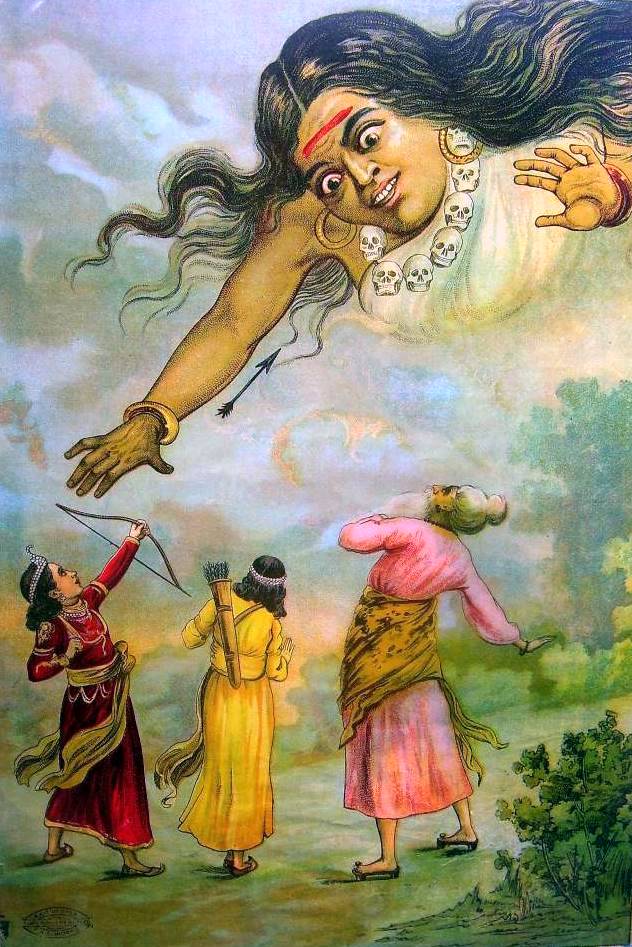
   After a period of time, the saint Agasthya began to take notice of the destruction being enacted by Sunda and his sons.  He cursed the person who caused such harm, causing Sunda to immediately die.  When Thataka came to rightfully seek vengeance on the person who killed the love of her life, he cursed her and her sons to transform from demigods into demons.  Doing this stripped them of their beauty, making their appearances fearful to behold.  After this occurred, Thataka was abandoned to her own devices and her sons went to seek other demons.  As time passed she grew more and more bitter towards humans.  She destroyed the land she dwelt in and killed all who dared to attempt crossing through her territory.  It continued in this manner until she was slain by Rama.
(Image of Thataka facing Rama and companions; Image source Wikipedia) 
   For this story, I chose to retell the story of Thataka by giving more of her background.  I thought that she was punished harshly for the actions of her family, and I wanted to make her seem more justified in her response.  I felt it was unfair for her to be transformed into what was basically her opposite solely because she grew angry and wanted revenge on the person who killed her husband.  
Narayan, R. K. (1972) The Ramayana.

Wednesday, August 20, 2014

Week 1: The Wolf and the Lamb

     The young lamb Henry was frolicking in the fields one day when he spotted a wolf stalking towards him.  As it approached, Henry grew cautious and stopped playing, choosing instead to look around for someone else.  Unfortunately for him, the herd had moved over the hill and his mother was not in sight. This meant that Henry would have to figure out a way to escape with his life.  After all, wolves were supposed to be bad, and Henry had been told not to go near them if they came.  In fact, he was supposed to go to straight to his mother if he even saw one. By the time Henry was through thinking this however, the wolf had gotten far too close to even try to escape.
     Mr. Wolf started speaking to Henry when he got closer, making comments that made Henry really uncomfortable. He was also drooling and making soft growling noises as he approached.  First Henry heard Mr. Wolf accuse him of making comments about him in the past, but he hadn't even been born at that time!  When he told Mr. Wolf this, he got really upset and started saying he was stealing his food and water.  Henry wasn't grown up yet though, so he could not eat solid foods or drink water like the grown ups.  The more that Henry spoke however, the closer Mr. Wolf came to him.  After the last comment, Mr. Wolf was growling loudly and pounced.  The last thing that Henry saw was Mr. Wolf's teeth.
     Even though Henry was young and innocent, this didn't prevent Mr. Wolf from attacking him. Henry's naivety allowed Mr. Wolf to get close and attack, taking advantage of Henry's youth to kill him. Mr. Wolf didn't feel bad for doing this, even though he tried to make an excuse for his actions at first.  The moral of this story is that evil people will always find a reason to commit bad deeds.
     In the original version, the story is told more from a third person perspective, rather than from the lamb's point of view. It shows how the wolf is trying to rationalize eating the lamb. Even though the lamb is proving all of his arguments to be false, the wolf has already decided to eat him and will find any reason to kill him and justify it.
The link to the story is http://mythfolklore.net/aesopica/townsend/1.htm